Available in the following sizes
07" x 17"
08" x 20"
11" x 27"
In January of 2023 I flew to Ushuaia at the southern tip of South America in Argentina.
It is part of the Tierra del Fuego archipelago and nicknamed the "end of the World".
It is a beautiful setting surrounded by the Martial Mountains and the Beagle Channel (named for Darwin's ship).
The next day I boarded the MS Fridtjof Nansen, an expedition ship owned by Hurtigruten.
This hybrid-powered ship hold a little more that 500 passengers.
We spent the next two days crossing the Drake Passage, named after the 16th century English explorer
Sir Francis Drake. The Drake Passage is considered one of the most treacherous voyages for ships anywhere in the world. The Antarctic Circumpolar Current runs through it and meets no resistance from any landmass.
We had 24 foot waves during our crossing, but sometimes they can be 40 feet.
Once down in Antarctica, each day we would get on inflatable Zodiac boats and land onshore for a walk on the continent. We also used the small boats for getting up closer to animals and icebergs.
We saw thousands of penguins, many birds and scores of whales on the trip.
Watching a group of penguins swimming by was incredible. These animals that are so awkward on land,
are so amazing in the water. They remind me of a pod of dolphins they way they fly out of the water.
A group of penguins in the water is called a raft, on land they are called a waddle.
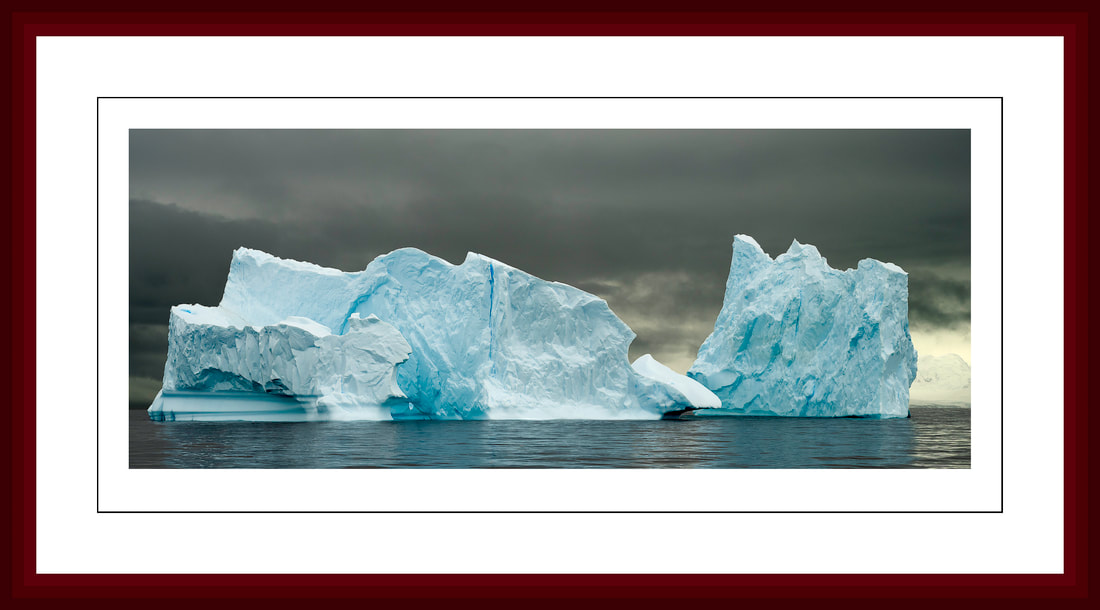
One day we were out on a small Zodiac boat and I saw these icebergs in the distance.
I asked the driver if we could move over to this area, at this angle for a photograph.
He did so, and it allowed me to line up the other icebergs to expose this image.
The icebergs change in color from white to extremely blue depending on the density of the ice.
compacted glacial ice absorbs longer light wavelengths, like reds and yellows, and
scatters shorter ones like blue. Similar to why the ocean appears blue.
Fresh snow on the ground or surface ice is not compacted much so they reflect all light and appear white.
It is part of the Tierra del Fuego archipelago and nicknamed the "end of the World".
It is a beautiful setting surrounded by the Martial Mountains and the Beagle Channel (named for Darwin's ship).
The next day I boarded the MS Fridtjof Nansen, an expedition ship owned by Hurtigruten.
This hybrid-powered ship hold a little more that 500 passengers.
We spent the next two days crossing the Drake Passage, named after the 16th century English explorer
Sir Francis Drake. The Drake Passage is considered one of the most treacherous voyages for ships anywhere in the world. The Antarctic Circumpolar Current runs through it and meets no resistance from any landmass.
We had 24 foot waves during our crossing, but sometimes they can be 40 feet.
Once down in Antarctica, each day we would get on inflatable Zodiac boats and land onshore for a walk on the continent. We also used the small boats for getting up closer to animals and icebergs.
We saw thousands of penguins, many birds and scores of whales on the trip.
Watching a group of penguins swimming by was incredible. These animals that are so awkward on land,
are so amazing in the water. They remind me of a pod of dolphins they way they fly out of the water.
A group of penguins in the water is called a raft, on land they are called a waddle.
One day we were out on a small Zodiac boat and I saw these icebergs in the distance.
I asked the driver if we could move over to this area, at this angle for a photograph.
He did so, and it allowed me to line up the other icebergs to expose this image.
The icebergs change in color from white to extremely blue depending on the density of the ice.
compacted glacial ice absorbs longer light wavelengths, like reds and yellows, and
scatters shorter ones like blue. Similar to why the ocean appears blue.
Fresh snow on the ground or surface ice is not compacted much so they reflect all light and appear white.